Vibrations, Waves & Optics
From mechanical oscillators to electromagnetic waves to quantum optics - the universal language of wave phenomena.
🌊 Why Waves & Optics Are Essential
Wave phenomena are universal across all of physics. The mathematical formalism and physical intuition developed here apply to:
- ⚡Plasma Physics: Electromagnetic waves, plasma waves (Langmuir, ion-acoustic), wave-particle interactions, dispersion relations
- ⚛️Quantum Mechanics: Wave functions, Schrödinger equation as wave equation, uncertainty principle from Fourier analysis
- 🌌Quantum Field Theory: Normal modes → field quantization, photons as quantized EM waves
- 🔬Plasma Diagnostics: Spectroscopy, interferometry, Thomson scattering, laser-based measurements
- 🌍Astrophysics: Gravitational waves, electromagnetic radiation from astronomical sources
Course Overview
This course follows a logical progression from simple mechanical oscillators through electromagnetic waves to the full theory of optics. Along the way, you'll develop essential mathematical tools (Fourier analysis, complex notation, dispersion relations) and physical concepts (resonance, normal modes, interference, diffraction) that appear everywhere in physics.
Part I - Mechanical Vibrations: Starting with the simple harmonic oscillator, we build up to coupled oscillators and normal modes. This provides the foundation for understanding how continuous media support wave propagation.
Part II - Electromagnetic Waves: Maxwell's equations lead to the electromagnetic wave equation. We explore phase velocity, group velocity, dispersion, and the Fourier transform approach to wave packets - essential for quantum mechanics and plasma physics.
Part III - Optics: Polarization, interference, and diffraction demonstrate the wave nature of light. These concepts extend to quantum waves and are crucial for experimental plasma physics (diagnostics) and quantum mechanics (wave-particle duality).
Key Concepts Covered
Part I: Mechanical Vibrations
- • Simple harmonic oscillator: fundamental building block
- • Damped oscillations: Q-factor, energy dissipation
- • Driven oscillations and resonance phenomena
- • Coupled oscillators and normal modes
- • Symmetry and degeneracy in coupled systems
- • Infinite coupled oscillators → wave equation
- • Standing waves and traveling waves
- • Fourier series for periodic phenomena
Part II: Electromagnetic Waves
- • Maxwell's equations in vacuum and media
- • Electromagnetic wave equation
- • Dispersion relations: ω(k) for different media
- • Phase velocity vs group velocity
- • Wave packets and Fourier transforms
- • Uncertainty principle from Fourier analysis
- • 2D and 3D wave propagation
- • Snell's law from boundary conditions
Part III: Optics
- • Polarization: linear, circular, elliptical
- • Polarizers and wave plates
- • Electromagnetic radiation and antennas
- • Waves in dispersive media
- • Interference: coherence and path differences
- • Thin film interference (soap bubbles, coatings)
- • Diffraction: single slit, multiple slits
- • Resolution limits and Rayleigh criterion
- • Quantum waves and wave-particle duality
Applications in Physics
- • Plasma waves: electromagnetic, electrostatic
- • Laser-plasma interactions
- • Thomson scattering diagnostics
- • Quantum mechanics: wave functions as waves
- • Field quantization: normal modes → photons
- • Gravitational wave detection
- • Spectroscopy and atomic physics
- • Solid state physics: lattice vibrations (phonons)
Fundamental Equations
Comprehensive derivations of the core equations governing wave phenomena, from mechanical vibrations through electromagnetic theory to optical effects, building each result from first principles.
1. The Wave Equation
Derivation from a vibrating string. Consider a string of linear mass density \( \mu \) under tension T. An infinitesimal element of length dx at position x is displaced vertically by \( u(x,t) \). The net vertical force on the element comes from the difference in the vertical components of tension at its two ends. For small displacements (\( \sin\theta \approx \tan\theta = \partial u/\partial x \)):
Applying Newton's second law (\( F = ma \)) to the element of mass \( dm = \mu\,dx \):\( \mu\,dx\,\frac{\partial^2 u}{\partial t^2} = T\frac{\partial^2 u}{\partial x^2}\,dx \). Dividing through by \( \mu\,dx \):
d'Alembert's general solution. Substituting the change of variables\( \xi = x - vt \), \( \eta = x + vt \) transforms the wave equation into\( \frac{\partial^2 u}{\partial\xi\,\partial\eta} = 0 \), which integrates to:
Any shape propagates without distortion at speed v: f travels right, g travels left. This is the most general solution and shows that wave propagation is a fundamental consequence of Newton's laws applied to elastic media.
2. Sinusoidal Traveling Waves
The most important special case of d'Alembert's solution is the harmonic (sinusoidal) traveling wave, which forms a complete basis for arbitrary waveforms via Fourier analysis:
Parameter definitions and relations:
- A: Amplitude (maximum displacement)
- k = 2π/λ: Wave number (spatial frequency)
- ω = 2πf: Angular frequency
- φ: Initial phase
Substitution into the wave equation requires \( \omega^2 = v^2 k^2 \), giving the fundamental relations:
Complex notation \( u = A\,e^{i(kx - \omega t)} \) (taking the real part) greatly simplifies calculations involving superposition, interference, and impedance matching.
3. Maxwell's Equations and the EM Wave Equation
The four Maxwell equations in differential form (SI units):
Derivation of EM wave equation. In free space (\( \rho = 0, \vec{J} = 0 \)), take the curl of Faraday's law:\( \nabla\times(\nabla\times\vec{E}) = -\frac{\partial}{\partial t}(\nabla\times\vec{B}) \). Using the vector identity \( \nabla\times(\nabla\times\vec{E}) = \nabla(\nabla\cdot\vec{E}) - \nabla^2\vec{E} \), with \( \nabla\cdot\vec{E} = 0 \) in free space, and substituting Ampere-Maxwell:
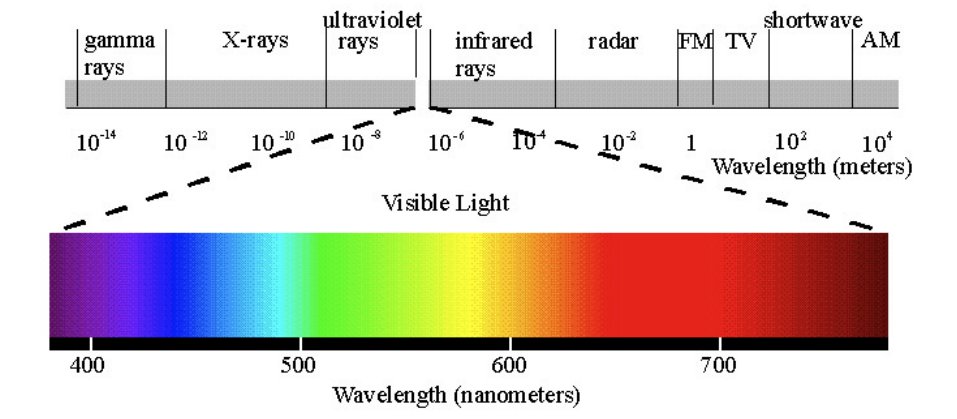
This is a wave equation with speed \( c = 1/\sqrt{\mu_0\epsilon_0} \approx 3\times 10^8 \) m/s. An identical equation holds for \( \vec{B} \). Maxwell's profound insight: light is an electromagnetic wave.
4. Electromagnetic Plane Waves
A monochromatic plane wave propagating in the x-direction has the form:
Faraday's law applied to this solution requires \( E_0 = cB_0 \). The E and B fields are perpendicular to each other and to the direction of propagation (transverse wave), and oscillate in phase.
Energy transport: Poynting vector. The energy flux (power per unit area) carried by the wave is:
The time-averaged intensity is \( \langle S \rangle = \frac{1}{2}\frac{E_0^2}{\mu_0 c} = \frac{1}{2}c\epsilon_0 E_0^2 \). The Poynting vector points in the direction of wave propagation and its magnitude gives the intensity (power per unit area) -- essential for understanding radiation pressure, antenna radiation patterns, and energy balance in optical systems.
5. Dispersion Relations
The dispersion relation \( \omega(k) \) encodes all propagation properties of a medium. It is obtained by substituting a plane-wave ansatz\( e^{i(kx - \omega t)} \) into the governing wave equation.
Phase and group velocity. These two distinct velocities characterize wave propagation:
The phase velocity is the speed of individual wave crests. The group velocity is the speed at which the envelope of a wave packet (and energy/information) propagates. When \( v_p \neq v_g \) the medium is dispersive: wave packets spread over time. Normal dispersion: \( dv_p/dk < 0 \) (\( v_g < v_p \)). Anomalous dispersion: \( dv_p/dk > 0 \) (\( v_g > v_p \)).
6. Superposition and Interference
Principle of superposition. The wave equation is linear, so any sum of solutions is also a solution. When two coherent waves of equal amplitude meet with a phase difference \( \delta \), their combined intensity follows from adding the amplitudes:
Two-source interference (Young's experiment). Two slits separated by distance d illuminate a distant screen. The path difference is \( \Delta = d\sin\theta \) and the phase difference is \( \delta = 2\pi d\sin\theta/\lambda \). The resulting intensity pattern:
Constructive interference (\( I = 4I_0 \)) when \( d\sin\theta = m\lambda \) (integer m). Destructive interference (\( I = 0 \)) when \( d\sin\theta = (m + \frac{1}{2})\lambda \). This fringe pattern provided the first definitive evidence for the wave nature of light (Thomas Young, 1801).
7. Diffraction
Single-slit Fraunhofer diffraction. When a plane wave passes through a slit of width a, each point in the aperture acts as a secondary source (Huygens' principle). In the far field (Fraunhofer limit), integrating contributions across the slit with path difference accounting:
Minima occur when \( \beta = m\pi \) (\( m = \pm 1, \pm 2, \ldots \)), i.e.,\( a\sin\theta = m\lambda \). The central maximum has angular half-width\( \theta_1 \approx \lambda/a \) -- smaller apertures produce wider diffraction patterns.
Fraunhofer vs Fresnel diffraction. Fraunhofer (far-field) diffraction applies when both source and observation point are effectively at infinity (\( a^2/\lambda L \ll 1 \), Fresnel number ≪ 1). Fresnel (near-field) diffraction includes the curvature of the wavefront and involves more complex Fresnel integrals.
8. Snell's Law of Refraction
Derivation from Fermat's principle. Light travels between two points along the path that minimizes the optical path length \( \int n\,ds \). For a ray crossing an interface between media with indices \( n_1 \) and \( n_2 \), minimizing the total transit time yields:
Alternative derivation from wavefront matching. At the boundary, the tangential component of the wave vector must be continuous (the wavefronts must match along the interface). Since \( k = n\omega/c \) and \( k_{\parallel} = k\sin\theta \):\( k_1\sin\theta_1 = k_2\sin\theta_2 \), which gives Snell's law.
Total internal reflection occurs when \( n_1 > n_2 \) and\( \theta_1 > \theta_c = \arcsin(n_2/n_1) \). The refracted angle would exceed 90 degrees, so all light is reflected. This is the basis for optical fibers and prism-based reflectors.
9. Fresnel Equations
Reflection and transmission at an interface. Applying the electromagnetic boundary conditions (continuity of tangential E and H) at a planar interface between media, we obtain the Fresnel amplitude coefficients for s-polarization (E perpendicular to plane of incidence) and p-polarization (E in the plane of incidence):
Brewster's angle. The p-polarized reflection coefficient vanishes (\( r_p = 0 \)) when \( n_2\cos\theta_i = n_1\cos\theta_t \). Combined with Snell's law, this gives:
At Brewster's angle, only s-polarized light is reflected. This is used in polarizing beam splitters and explains why sunlight reflected from water/glass at glancing angles is partially polarized (polarized sunglasses exploit this effect).
10. Fourier Transform and Wave Packets
Any waveform can be decomposed into sinusoidal components. The Fourier transform pair relates a function in position space to its spectral content in wave-number space:
Uncertainty principle. A fundamental property of Fourier transform pairs: the widths of a function and its transform are inversely related. For a wave packet with spatial width\( \Delta x \) and spectral width \( \Delta k \):
A well-localized wave packet (small \( \Delta x \)) requires a broad spectrum (large\( \Delta k \)), and vice versa. Using de Broglie's relation \( p = \hbar k \), this becomes the Heisenberg uncertainty principle \( \Delta x\,\Delta p \geq \hbar/2 \) -- the quantum mechanical uncertainty principle is purely a property of waves.
11. Thin Lens and Lensmaker's Equation
Derivation from refraction at two surfaces. Apply Snell's law (in the paraxial/small-angle approximation \( \sin\theta \approx \theta \)) to refraction at a single spherical surface of radius R separating media \( n_1 \) and \( n_2 \):\( \frac{n_1}{s} + \frac{n_2}{s'} = \frac{n_2 - n_1}{R} \). Applying this twice (front and back surfaces of the lens) and taking the thin-lens limit (lens thickness ≈ 0) gives the Lensmaker's equation:
where n is the lens refractive index (in air), and \( R_1, R_2 \) are the radii of curvature of the two surfaces. The thin lens equation relating object and image distances:
The magnification is \( M = -d_i/d_o \). A negative \( d_i \) indicates a virtual image (same side as object). This equation forms the basis of geometric optics and optical instrument design -- microscopes, telescopes, cameras, and the human eye all obey this relation.
12. Rayleigh Criterion (Resolution Limit)
Diffraction limits resolution. A circular aperture of diameter D produces an Airy diffraction pattern (the 2D analog of the sinc-squared pattern). The angular radius of the first dark ring is obtained from the zeros of the Bessel function \( J_1 \):
The Rayleigh criterion states that two point sources are just resolvable when the central maximum of one falls on the first minimum of the other -- that is, when their angular separation equals \( \theta_{\min} \).
This is a fundamental limit: no matter how perfect the optics, diffraction sets the ultimate resolution. For a telescope with D = 10 cm observing at \( \lambda \) = 550 nm:\( \theta_{\min} \approx 6.7\times 10^{-6} \) rad ≈ 1.4 arcseconds. Larger apertures and shorter wavelengths give better resolution -- this drives the construction of large telescopes and the use of electron microscopy (shorter de Broglie wavelength) for higher resolution imaging.
Summary of Key Equations
| Equation | Expression | Domain |
|---|---|---|
| Wave Equation | \( \partial^2 u/\partial t^2 = v^2\,\partial^2 u/\partial x^2 \) | Mechanical / general |
| Traveling Wave | \( u = A\sin(kx - \omega t + \varphi) \) | Harmonic waves |
| EM Wave Equation | \( \nabla^2\vec{E} = \mu_0\epsilon_0\,\partial^2\vec{E}/\partial t^2 \) | Electromagnetism |
| Poynting Vector | \( \vec{S} = (1/\mu_0)\vec{E}\times\vec{B} \) | EM energy flux |
| Phase / Group Velocity | \( v_p = \omega/k \), \( v_g = d\omega/dk \) | Dispersion |
| Two-Source Interference | \( I = 4I_0\cos^2(\delta/2) \) | Coherent sources |
| Single-Slit Diffraction | \( I = I_0[\sin\beta/\beta]^2 \) | Fraunhofer limit |
| Snell's Law | \( n_1\sin\theta_1 = n_2\sin\theta_2 \) | Refraction |
| Brewster's Angle | \( \tan\theta_B = n_2/n_1 \) | Polarization |
| Uncertainty Principle | \( \Delta x\,\Delta k \geq 1/2 \) | Fourier / quantum |
| Thin Lens | \( 1/f = 1/d_o + 1/d_i \) | Geometric optics |
| Rayleigh Criterion | \( \theta_{\min} = 1.22\lambda/D \) | Resolution limit |
🔗 Connections to Advanced Physics
→ Plasma Physics
Electromagnetic Waves in Plasmas: Essential foundation for understanding plasma wave phenomena.
- • Dispersion relations for plasma waves (Langmuir, ion-acoustic, lower-hybrid)
- • Wave-particle interactions and Landau damping
- • Laser-plasma interactions: ponderomotive force, parametric instabilities
- • Plasma diagnostics: Thomson scattering, interferometry, spectroscopy
- • Electromagnetic wave propagation: cutoff frequencies, resonances
→ Quantum Mechanics
Wave Functions as Waves: Direct application of wave concepts to quantum particles.
- • Schrödinger equation is a wave equation for matter waves
- • Uncertainty principle Δx·Δp ≥ ℏ/2 from Fourier analysis (Δx·Δk ≥ 1/2)
- • Wave packets represent localized quantum particles
- • Interference and diffraction → wave-particle duality
- • Group velocity → particle velocity in de Broglie waves
→ Quantum Field Theory
Field Quantization from Normal Modes: Photons emerge from quantized EM waves.
- • Normal modes of EM field → creation/annihilation operators
- • Each normal mode is a quantum harmonic oscillator
- • Photons are quanta of electromagnetic field oscillations
- • Vacuum fluctuations from zero-point energy of oscillators
- • Dispersion relations extend to relativistic particles: E² = p²c² + m²c⁴
📺 Video Lecture Series
Professor Yen-Jie Lee - MIT
22 comprehensive lectures covering the complete progression from simple harmonic motion through electromagnetic waves to optics. Professor Lee's clear explanations and experimental demonstrations make abstract wave concepts concrete and intuitive.
Course structure:
- • Part I (10 lectures): Mechanical vibrations - harmonic oscillators, damping, resonance, coupled systems, wave equation
- • Part II (5 lectures): Electromagnetic waves - Maxwell's equations, dispersion, Fourier analysis, uncertainty principle
- • Part III (7 lectures): Optics - polarization, interference, diffraction, quantum waves, gravitational waves
A Particularly Wavy Matter
📚 Recommended Textbooks
A.P. French
Vibrations and Waves (MIT Introductory Physics Series)
Classic MIT text. Excellent for building intuition. Clear explanations with many worked examples. Perfect companion to Professor Lee's lectures.
D.J. Griffiths
Introduction to Electrodynamics (4th Edition)
The standard text for electromagnetic waves. Chapter 9 on EM waves is essential. Clear derivations, excellent problems.
E. Hecht
Optics (5th Edition)
Comprehensive optics text. Covers geometric and wave optics, interference, diffraction, polarization. Many applications and beautiful illustrations.
J.D. Jackson
Classical Electrodynamics (3rd Edition)
Advanced graduate text. For those wanting deeper understanding of EM waves and radiation. Challenging but rewarding.
Prerequisites
- ✓Calculus & Differential Equations:
Single and multivariable calculus, ODEs (simple harmonic oscillator), basic PDEs (wave equation). Complex numbers and Euler's formula e^(iωt).
- ✓Introductory Physics:
Newton's laws, kinematics, energy. Basic understanding of electric and magnetic fields helpful for Part II.
- ✓Linear Algebra (helpful):
Matrices and eigenvalues for coupled oscillator problems. Not strictly required but very useful.
Related Courses
Classical Mechanics
Lagrangian and Hamiltonian formulations - foundation for understanding oscillators and normal modes.
Explore Classical Mechanics →Plasma Physics
EM waves in plasmas, wave-particle interactions, diagnostics - direct applications of wave theory.
Explore Plasma Physics →Quantum Mechanics
Wave functions, Schrödinger equation, uncertainty principle - quantum waves extend classical wave concepts.
Explore Quantum Mechanics →Quantum Field Theory
Field quantization from normal modes, photons as quantized EM waves - waves become quantum fields.
Explore QFT →