Graduate Research Course
Spider Biophysics & Biochemistry
From silk nanostructure to hydraulic locomotion — the biomechanics, material science, venom pharmacology, and sensory physics of nature's most sophisticated engineers.
Key Equations of Spider Biophysics
Silk Tensile Strength
\( \sigma_{ult} = 1.1\,\text{GPa}, \quad \varepsilon_{break} = 30\%, \quad U = 160\,\text{MJ/m}^3 \)
Web Spiral Geometry
\( r(\theta) = a + b\theta \quad \text{(Archimedean spiral)} \)
Venom Dose-Response
\( P_{lethal} = 1 - \exp\!\left(-\left(\frac{D}{LD_{50}}\right)^n\right) \)
Hydraulic Leg Pressure
\( P_{hemolymph} = \frac{F_{prosoma}}{A_{leg}} \approx 60\,\text{kPa (max)} \)
Slit Sensilla Strain
\( \Delta L / L = \varepsilon_{substrate} \cdot G(\theta, f) \)
Ballooning Lift Criterion
\( F_{drag} = \frac{1}{2}C_D \rho v^2 A_{silk} > mg \)
Featured Videos
Exploring the Incredible Abilities of Spiders
Spiders in Our Gardens
Spiders: Tiny Tool Using Tigers — Backyard Naturalist Lecture Series
About This Course
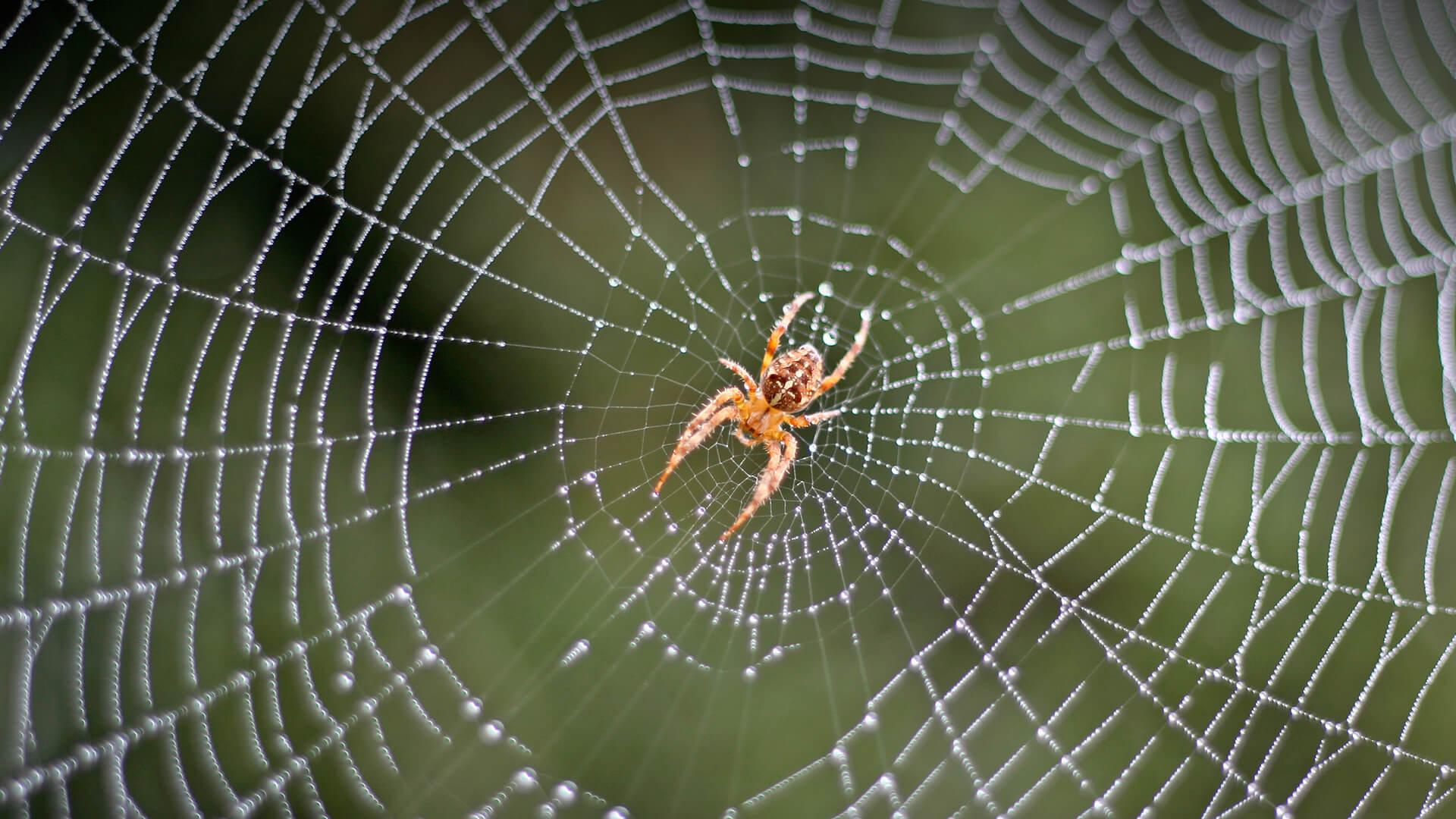
Spiders (order Araneae) are among the most biomechanically remarkable organisms on Earth. Dragline silk achieves a tensile toughness of 160 MJ/m³, surpassing Kevlar and high-tensile steel. With no extensor muscles in their legs, spiders instead use hydraulic hemolymph pressure reaching 60 kPa to extend their limbs — a locomotion strategy unique in the animal kingdom.
This course examines every facet of spider biology through the lens of physics and chemistry: the nanostructure of beta-sheet crystals in silk proteins, the structural engineering of orb webs, the ion-channel pharmacology of spider venoms, the optics of jumping spider eye tubes, and the exquisite mechanosensory physics of slit sensilla and trichobothria.
Every module includes MathJax derivations, SVG diagrams, and computational models. Cross-links to our Insect Biophysics and Bee Biophysics courses connect arthropod biomechanics and comparative physiology.
Nine Modules
M0
Physical Foundations
Exoskeleton biomechanics, book lung gas exchange, hemolymph hydraulic systems, and allometric scaling across 48,000+ species.
M1
Silk Mechanics & Chemistry
Seven silk types, spidroin protein self-assembly, beta-sheet nanocrystals, the spinning process, and stress-strain mechanics of dragline silk.
M2
Web Architecture & Physics
Orb web geometry, Archimedean spiral construction, prey capture impact mechanics, energy absorption, and web recycling biochemistry.
M3
Venom Biochemistry
Neurotoxins and cytotoxins, ion channel pharmacology, dose-response modeling, and spider venom peptides as pharmaceutical drug leads.
M4
Hydraulic Locomotion
No extensor muscles — hydraulic leg extension via hemolymph pressure, prosoma pump mechanics, and jumping spider ballistics.
M5
Sensory Systems
Slit sensilla mechanoreceptors, trichobothria airflow detection, lyriform organ vibration sensing, and substrate-borne prey detection.
M6
Vision & Color
Jumping spider acute vision, salticid eye tube optics, UV perception, and structural coloration in peacock spider courtship displays.
M7
Reproduction & Development
Sexual cannibalism biomechanics, sperm web construction, egg sac silk engineering, and the mechanics of exoskeletal molting.
M8
Evolution & Diversity
48,000+ species diversity, orb web evolutionary origins, ballooning dispersal aerodynamics, and spider phylogenomics.
M9
Molecular & Biochemistry
Cuticle quinone tanning, copper-based haemocyanin O₂ transport, hemolymph hydraulic-pressure chemistry, salticid tetrachromatic vision (3-hydroxyretinal), CHC pheromones & silk markers, silk-spinning pH/salt gradient triggers.
Recommended Textbooks
- [1] Foelix, R.F. (2011). Biology of Spiders, 3rd ed. Oxford University Press.
- [2] Craig, C.L. (2003). Spiderweb and Silk: Tracing Evolution from Molecules to Genes to Phenotypes. Oxford University Press.
- [3] Herberstein, M.E. (ed.) (2011). Spider Behaviour: Flexibility and Versatility. Cambridge University Press.
- [4] Nentwig, W. (ed.) (2013). Spider Ecophysiology. Springer.