Graduate Research Course
The Cytoskeleton
Actin, microtubules, intermediate filaments and their motors — the molecular machinery that gives cells shape, motility, and the ability to divide.
About This Course
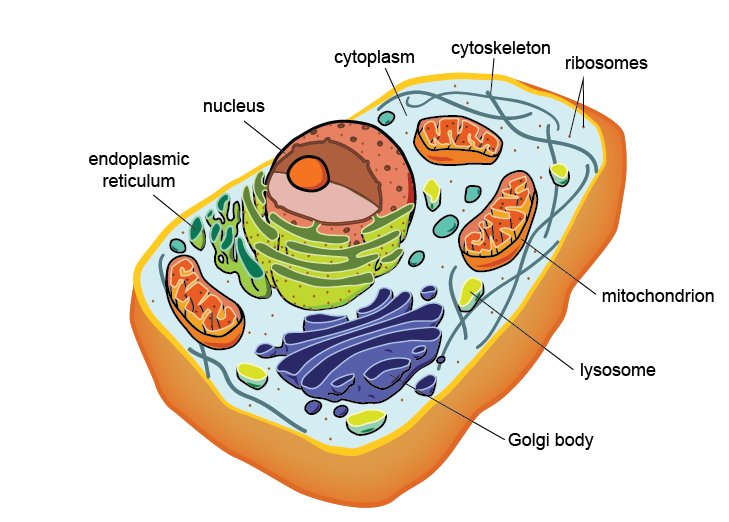
The cytoskeleton is how biology does architecture and engineering at the nanoscale. Three classes of polymer — actin, microtubules, and intermediate filaments — support the shape of every eukaryotic cell, power its migration, drive chromosome segregation at mitosis, power sperm tails and cilia, and mediate every muscle contraction. Each filament is a self-assembled, out-of-equilibrium polymer with specific nucleotide chemistry (ATP for actin, GTP for microtubules) and a dedicated family of motor proteins that walks along it, carrying cargo.
Cross-links: Biophysics,Biochemistry,Molecular Biology,Biophysics: Molecular Motors.
Key Equations
Actin Polymerization
\( \frac{d[F]}{dt} = k_+[G][F_{ends}] - k_-[F_{ends}] \)
Critical Concentration
\( [G]_c = k_-/k_+ \)
Dynamic Instability (MT)
\( p_{cat} \cdot v_g = p_{res} \cdot v_s \)
Motor Step Efficiency
\( \eta = F \cdot d / \Delta G_{ATP} \)
Hill Force-Velocity
\( (F+a)(v+b) = (F_0+a)b \)
Bending Stiffness
\( L_p = EI / k_B T \)
Nine Modules
M0
Overview & Historical Context
Three-filament architecture, Huxley 1954 sliding filament, Spudich actin nucleotide switch, Alberts textbook framework, cytoskeletal evolution.
M1
Actin Filaments
G-actin to F-actin polymerization, ATP hydrolysis, Oosawa kinetics, critical concentration, treadmilling, Arp2/3 branching, formins, cofilin severing.
M2
Microtubules
13-protofilament lattice, GTP cap and dynamic instability (Mitchison-Kirschner 1984), α/β-tubulin, catastrophe/rescue, γ-tubulin nucleation, MAPs.
M3
Intermediate Filaments
Coiled-coil dimers (keratins, vimentin, lamins, desmin), non-polar assembly, mechanical resilience, Herrmann 2009 hierarchy, laminopathies.
M4
Motor Proteins
Myosin II and V processive stepping, kinesin 8-nm step, dynein minus-end motor, Hill force-velocity, Rice & Purcell lever-arm, optical-trap single-molecule.
M5
Regulation & Signaling
Rho GTPases (RhoA/Rac1/Cdc42), MLCK, Arp2/3 activation by WASP, Formin FH1-FH2 mechanism, cofilin pH/phospho regulation, mDia profilin handoff.
M6
Cell Shape & Mechanics
Cortical tension, prestress, tensegrity (Ingber), cell traction force microscopy, substrate stiffness mechanosensing, Engler 2006, Wirtz 2009.
M7
Muscle Contraction
Sliding-filament mechanics, Huxley 1957 cross-bridge cycle, tropomyosin-troponin-Ca2+ switch, titin passive stiffness, sarcomere length-tension curve.
M8
Disease & Therapeutics
Cancer metastasis migration, Duchenne muscular dystrophy, laminopathies, paclitaxel & vinca alkaloids, latrunculin, actin drugs, cilia/flagella disorders.