Solar Wind
Parker's hydrodynamic model, the heliosphere, and the Parker spiral
1.1 Parker's Solar Wind Model
In 1958, Eugene Parker proposed that the solar corona cannot be in static equilibrium and must expand outward as a supersonic wind. This was one of the most important predictions in space physics, confirmed by Mariner 2 in 1962.
1.1.1 Why the Corona Must Expand
Consider a static, isothermal corona in hydrostatic equilibrium:
For an ideal gas p = nkBT = ρkBT/(mp/2) (hydrogen plasma, mean molecular weight μ ≈ 1/2), the solution is:
As r → ∞, the pressure approaches a finite value:
For T ≈ 106 K (coronal temperature), p∞ ≈ 10−5 p0 ≈ 10−4 Pa. This is much larger than interstellar pressure (pISM ≈ 10−13 Pa). Therefore, a static corona is not in pressure balance with the ISM — it must expand.
1.1.2 Derivation of Parker's Equation
We derive the steady-state, spherically symmetric, isothermal solar wind solution.
Full Derivation
Step 1. Start with mass continuity for steady, spherically symmetric flow:
Step 2. Radial momentum equation with gravity:
Step 3. For an isothermal plasma, p = ρcs² where cs² = 2kBT/mp(including both electrons and ions). Then dp/dr = cs²(dρ/dr).
Step 4. From continuity: d(r²ρv) = 0 → ρ' = −ρ(v'/v + 2/r). Substitute:
Step 5. Dividing by ρ and rearranging:
Step 6. Factor dv/dr:
This is Parker's wind equation. It is a first-order ODE with a critical point.
1.1.3 Critical Point Analysis
The equation has a singularity where the left-hand side vanishes: v = cs (the sonic point). For a smooth (non-singular) solution passing through v = cs, the right-hand side must also vanish simultaneously. Setting both sides to zero:
This defines the critical (sonic) radius:
For T = 106 K: rc ≈ 5.8 R☉ ≈ 4 × 10⁹ m. At this distance the flow transitions from subsonic to supersonic.
1.1.4 Solution Topology
Integrating Parker's equation yields the implicit solution:
This equation has four families of solutions:
Type I — Solar Wind Solution
Starts subsonic at the Sun, passes through the critical point, becomes supersonic. This is Parker's solar wind — the physically realized solution.
Type II — Accretion Solution
The time-reverse: starts supersonic at infinity, decelerates through the critical point. Relevant for Bondi accretion onto compact objects.
Types III & IV — Unphysical
Subsonic everywhere or supersonic everywhere. These don't satisfy physical boundary conditions (finite pressure at infinity or matching coronal conditions at the base).
1.1.5 Solar Wind Parameters at 1 AU
From the sonic point solution, the asymptotic velocity and the observed solar wind properties at r = 1 AU ≈ 215 R☉ are:
- • Slow wind: v ≈ 400 km/s, n ≈ 10 cm−3, T ≈ 5 × 10⁴ K, B ≈ 5 nT
- • Fast wind: v ≈ 750 km/s, n ≈ 3 cm−3, T ≈ 2 × 10⁵ K, B ≈ 5 nT
- • Mass loss rate: Ṁ ≈ 2 × 10⁻¹⁴ M☉/yr ≈ 109 kg/s
The mass loss rate follows from continuity:
1.2 The Parker Spiral
The Sun rotates with angular velocity Ω☉ ≈ 2.7 × 10⁻⁶ rad/s (period ≈ 27 days). The magnetic field, frozen into the rotating corona, is wound into an Archimedean spiral as the wind carries it outward.
1.2.1 Derivation of the Spiral Angle
Derivation
Step 1. In the inertial frame, the radial velocity is vr and the magnetic field foot-point on the Sun moves azimuthally with velocity vφ = Ωr sin θ. For ideal MHD (frozen-in flux), the field line satisfies:
Step 2. In the co-rotating frame (where the foot-point is stationary), the plasma moves purely radially. The azimuthal field component arises because the radial flow stretches the field in the azimuthal direction:
where rA is the Alfvén radius (where vr = vA). For r ≫ rA:
Step 3. The spiral angle ψ between the field and the radial direction:
At 1 AU in the ecliptic (θ = π/2):
The field line shape in the equatorial plane is an Archimedean spiral:
1.2.2 Magnetic Field Scaling
From ∇·B = 0 in spherical coordinates, the radial field must scale as:
The azimuthal component Bφ = −Br(Ωr sin θ/vr) scales as:
Thus at large distances, Bφ dominates and the total field falls as 1/r rather than 1/r²:
1.3 Weber-Davis MHD Wind
Weber & Davis (1967) extended Parker's model to include the magnetic field self-consistently. The rotating, magnetized wind has three critical points (slow, Alfvénic, fast) instead of one.
1.3.1 Conservation Laws
For a steady, axisymmetric, ideal MHD flow in the equatorial plane, three quantities are conserved along field/streamlines:
Mass flux:
Total angular momentum per unit mass (magnetic + kinetic):
Total energy per unit mass (Bernoulli integral):
1.3.2 The Alfvén Radius
The Alfvén radius rA is where vr = vA = Br/√(μ₀ρ). At this point, the flow transitions from magnetically dominated (sub-Alfvénic) to kinetically dominated (super-Alfvénic). Angular momentum conservation gives:
For the Sun, rA ≈ 10-20 R☉. The magnetic field acts as a rigid lever arm out to rA, enforcing co-rotation. Beyond rA, the field is wound up into the Parker spiral.
1.3.3 Angular Momentum Loss
The rate of angular momentum loss from the Sun is:
This is equivalent to the angular momentum that would be carried away if the wind co-rotated out to rA and then decoupled. The magnetic field enhances the angular momentum loss by a factor (rA/R☉)² ∼ 100-400 compared to a non-magnetic wind. Thismagnetic braking explains why the Sun rotates much more slowly than expected.
Stellar Spin-Down
For solar-type stars, magnetic braking leads to the Skumanich law:
This t−1/2 dependence has been confirmed observationally in stellar clusters of different ages, providing a gyrochronology tool for dating stars.
1.4 The Heliosphere
The heliosphere is the bubble carved out by the solar wind in the interstellar medium (ISM). Its structure involves three boundaries:
1.4.1 Termination Shock
The supersonic solar wind must decelerate to match the subsonic flow required by pressure balance with the ISM. This occurs at the termination shock. Its location follows from balancing the dynamic pressure of the wind with the ISM pressure:
Using mass continuity ρsw(r) = ρ0(r0/r)² and known values at 1 AU:
Derivation of Termination Shock Distance
Step 1. The wind ram pressure at distance r:
where subscript E denotes values at Earth (1 AU). Using nE ≈ 5 cm−3, v ≈ 400 km/s:
Step 2. Setting pram(rTS) = pISM ≈ 2 × 10⁻¹³ Pa:
Voyager 1 crossed the termination shock at 94 AU in 2004, and Voyager 2 at 84 AU in 2007, confirming this estimate.
1.4.2 Heliopause and Bow Shock
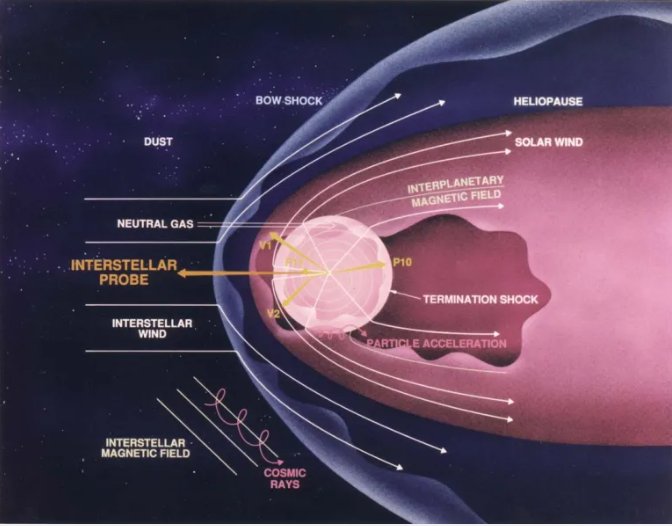
Beyond the termination shock lies the heliosheath — hot, subsonic solar wind plasma. The heliopause is the contact surface separating solar and interstellar plasma. Voyager 1 crossed it at 121 AU in 2012.
If the ISM flow (vISM ≈ 26 km/s) is supersonic relative to the ISM sound speed, a bow shock forms upstream. Recent IBEX data suggest the ISM flow is actually sub-fast-magnetosonic, so the bow shock may not exist — replaced by a gradual "bow wave."
1.4.3 Heliospheric Current Sheet
The Sun's magnetic dipole is tilted ≈ 7° from the rotation axis. The equatorial current sheet where Br reverses sign is warped into a ballerina skirt pattern by solar rotation. Its shape is described by:
where α is the tilt angle. This creates sector structure: alternating toward/away magnetic polarity as the sheet sweeps past Earth with the 27-day rotation period.
1.5 Energy Budget of the Solar Wind
The total energy flux in the solar wind at distance r is:
The four terms represent kinetic energy flux, enthalpy flux, gravitational potential energy flux, and Poynting flux (electromagnetic energy). The Poynting flux is:
At 1 AU, the kinetic energy flux dominates (∼ 99%), and the total solar wind luminosity is:
The Coronal Heating Problem
The solar photosphere has T ≈ 5800 K, but the corona is T ≈ 106 K. The mechanism heating the corona to millions of degrees remains one of the great unsolved problems in astrophysics. Leading candidates include:
- • Wave heating: Alfvén waves dissipate via phase mixing or turbulent cascade
- • Nanoflares: Many small reconnection events (Parker 1988)
- • Magnetic braiding: Photospheric motions tangle field lines, driving currents
The required heating rate is ∼105 W/m² for active regions and ∼300 W/m² for quiet Sun.
Interactive Simulations
Parker Solar Wind Model: Velocity vs Distance
PythonClick Run to execute the Python code
Code will be executed with Python 3 on the server
Solar Wind Ram Pressure and Magnetopause Distance
FortranClick Run to execute the Fortran code
Code will be compiled with gfortran and executed on the server